Beyond the Compressor Unit: QuanWei’s System-Level Optimization for Air Production Efficiency
January 06, 2026
Many factories prioritize individual air compressor performance when striving for higher air production efficiency, yet they often overlook the critical role of overall air supply system coordination. Pipeline design, filters, pressure regulators, and other auxiliary components directly determine the final operational efficiency. Even a high-performance compressor may fail to deliver its full potential if paired with an unreasonable pipeline layout or mismatched auxiliary parts. The key to maximizing air production efficiency lies in system-level holistic optimization. QuanWei Machinery combines its advanced compressor products with professional system design capabilities, offering comprehensive solutions for factories to fully unlock the latent value of their air supply systems.
1. Pipeline Layout Optimization: Eliminate "Invisible Resistance" to Air Flow
Pipelines serve as the "blood vessels" of an air supply system. Suboptimal designs—such as excessive bends, undersized diameters, or unnecessarily long runs—will increase air flow resistance, leading to significant pressure loss and energy waste. QuanWei’s professional technical team optimizes pipeline layouts based on each factory’s unique spatial structure and air demand distribution. By reducing unnecessary bends, selecting appropriately sized pipes, and strategically placing branch nodes, the pressure loss of the entire pipeline system is minimized. According to QuanWei’s on-site optimization case data, scientific pipeline adjustments have consistently achieved a 15%-20% reduction in system pressure loss, ensuring that the compressed air produced by the compressor is efficiently delivered to all production terminals.
2. Matching of Auxiliary Components: Avoid "Efficiency Drag" of the System
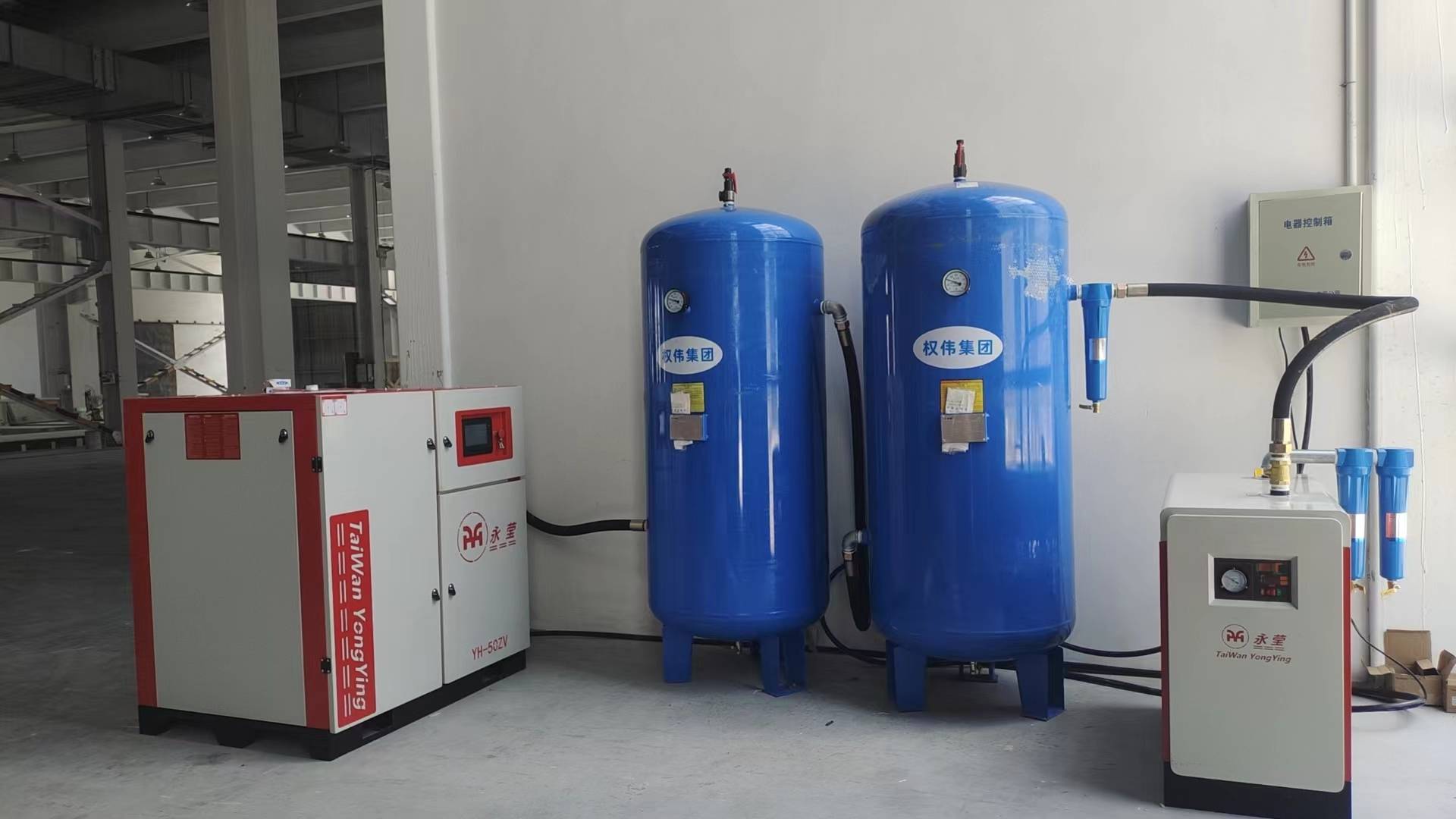
Auxiliary components including filters, dryers, and pressure regulators are often considered secondary elements, but their compatibility with the main compressor directly impacts the overall system efficiency. For instance, an improperly selected filter can cause excessive air flow resistance, while an inefficient dryer will increase energy consumption and compromise air quality. QuanWei provides customized auxiliary component matching solutions tailored to different compressor models and specific production requirements. By pairing compressors with QuanWei’s high-efficiency precision filters and energy-saving dryers, the system maintains stable air quality while minimizing "efficiency drag". Based on accumulated data from hundreds of QuanWei’s successful projects, rational matching of auxiliary components has been proven to further improve the overall system energy efficiency by 8%-12%.
3. Intelligent Pressure Regulation: Balance Supply and Demand Without Waste
Unstable system pressure or overly high pressure settings are another major cause of energy waste. Many factories set the compressor’s discharge pressure higher than necessary to prevent insufficient pressure at the production end, resulting in unnecessary energy consumption. QuanWei’s intelligent pressure regulation system addresses this issue directly. It monitors the pressure at each production node in real time and dynamically adjusts the compressor’s operating pressure according to actual demand, avoiding waste caused by excessive pressure while ensuring stable air supply. When used in conjunction with QuanWei’s permanent magnet variable frequency air compressors, the system achieves precise supply-demand matching, further enhancing energy-saving effects—a result that has been fully verified in numerous industrial applications by QuanWei’s technical team.
4. System Inspection and Optimization: Tap Potential Based on Actual Conditions
System optimization is not a one-time task but requires dynamic adjustments in response to changes in production conditions. QuanWei offers systematic inspection and optimization services for factories. By comprehensively testing the operational status of the entire air supply system—including pipeline leakage, component aging, and pressure fluctuations—QuanWei’s technicians identify potential efficiency bottlenecks. Targeted optimization measures are then formulated based on the inspection results, such as repairing pipeline leaks, replacing aging parts with QuanWei’s high-efficiency components, and adjusting pressure parameters. Periodic system optimization ensures that the air supply system always operates at its peak performance level, guaranteeing long-term stable and efficient operation. This is also a core component of QuanWei’s after-sales technical support service package.
The core of QuanWei’s system-level optimization lies in the concept of "holistic coordination": it does not simply stack high-performance products but deeply integrates every link of the air supply system to create a synergistic effect. Through pipeline layout optimization, auxiliary component matching, intelligent pressure regulation, and periodic inspection and adjustment, the system’s air production efficiency is comprehensively improved, and energy consumption is reduced at the source. For factories pursuing lean operation, QuanWei’s system-level optimization solution provides a new path for efficiency improvement and cost reduction, helping enterprises achieve more stable and efficient air supply support.
This is the WhatsApp QR code. You can obtain more information by email or adding me as a WhatsApp contact.Welcome to consult us for any questions!
+WhatsApp:+86 18913182127
+WeChat:18913182127
E-mail:z17394000986@163.com
Could you please inform me of the following basic parameters in the email so that I can provide you with a better quotation:
• Voltage
• Frequency (Hz)
• Motor Power
• Pressure
• Flow Rate





 شبكة IPv6 المدعومة